
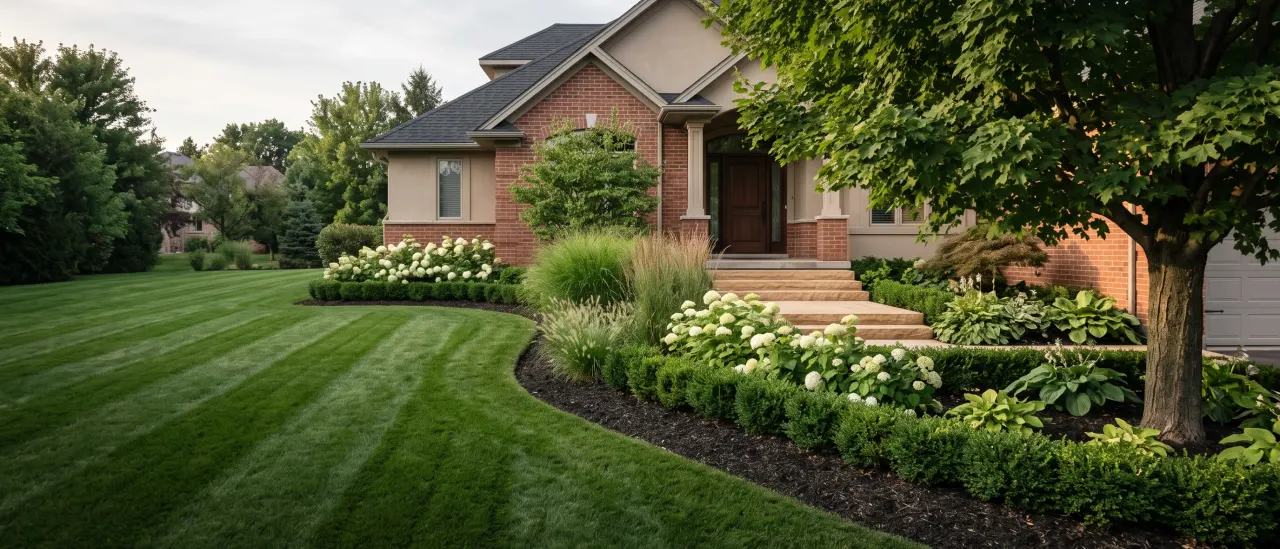
Timing changes the result, not just the calendar
Almost every outdoor job has a window where it goes well and a window where it goes badly. It is not about convenience. Wood will not take a finish below a certain temperature. A tree pruned in the wrong month loses more than it needs to. Snow clearing arranged after the first storm is arranged in a queue behind everyone else who waited.
The other half of it is capacity. Outdoor trades in York Region are seasonal by nature, which means demand arrives in the same few weeks for everyone at once — the first warm weekend in spring, the first leaf drop in October, the first snowfall. Work booked inside those spikes competes for the same days. Work booked ahead of them does not.
This is a walkthrough of the year by service, with the reason behind each window rather than just the month. If you are starting from scratch, skip to the last section — it covers what to do first when you are already mid-season.
If you only take one thing from this: book snow clearing before the first snowfall and book spring clean-up before the snow finishes melting. Those are the two windows that close hardest.
Spring: clear first, then plant
Spring work has a natural order, and doing it out of order means paying to do parts of it twice.
The first job is the clean-up: winter debris, matted leaves missed in the fall, salt-damaged edges, broken branches brought down by ice. This wants to happen as the ground firms up but before growth starts in earnest — roughly once the snow has gone and the lawn is walkable without leaving footprints in it. Clearing before growth starts means you are removing debris, not removing debris out of new growth.
Bed work, mulching and weeding follow, then lawn care as the grass starts moving. Doing mulch before the clean-up buries the debris you were about to remove; doing it after means one pass.
- Yard clean-up: as soon as the ground is firm and walkable
- Beds, mulching, weeding: after the clean-up, before growth accelerates
- First lawn cut and ongoing care: once growth is steady
- Fence and gate repairs: early, while beds are still bare and access is easy
That last one is the underrated window. A fence line is far easier to work on before the beds in front of it have filled in — and the same is true of anything against a wall or under a tree.
Summer: maintenance, plus the only real window for wood
Summer is mostly upkeep — lawn care on a rhythm, beds kept in shape, growth kept off paths and structures. The reason it matters for planning is that summer is the only dependable window for deck and fence refinishing.
Stains and oils need dry wood, dry weather either side of the application, and temperatures in a workable band. In Southern Ontario that realistically means late spring through early autumn, and it means the job is weather-dependent inside that window too — which is why a refinishing date can move. A deck stripped and left waiting on rain is worse off than one not started.
Tree work splits here. Structural pruning is better in the dormant season (see below), but summer is when you find out what actually needs doing: a limb over the roof is obvious in leaf and easy to miss bare. Summer is for the assessment; winter is usually for the cut.
- Lawn care and bed maintenance: on a rhythm through the season
- Deck and fence refinishing: the main window, weather permitting
- Tree assessment: while the canopy is full and you can see the problem
- Hedge and growth control: as it encroaches on paths, fences and rooflines
A refinishing job booked for a specific weekend in summer can still move. Wood that is not dry, or rain arriving inside the cure window, will spoil the finish — the visit gets rescheduled rather than pushed through.
Fall: the busiest window, and the one most often left late
Fall is where waiting costs the most, because three things want to happen in the same handful of weeks and one of them has a hard deadline.
Leaf and debris clearing has to happen after the drop but before the ground freezes and before snow lands on top of it. Leaves left under snow do not wait politely — they mat, hold moisture against the lawn all winter, and become a spring problem instead of a fall one. That is the same job done twice.
Tree work moves into its best window as the leaves come off. A bare canopy shows structure clearly, the tree is heading into dormancy, and access across beds is easier with nothing growing in them. If the summer assessment found something, this is when it gets cut.
And snow clearing gets arranged now — not in December. This is the single most common scheduling mistake: waiting for the first snowfall to think about snow. By then everyone else is calling too, and the days are already allocated.
- Leaf and debris clearing: after the drop, before the freeze
- Tree pruning and removals: as the canopy comes bare
- Final cut and bed prep: before the first hard frost
- Snow clearing arrangements: before the first snowfall, not after
Winter: clearing, salting, and the quiet window for tree work
Winter work is reactive by definition — snow arrives when it arrives — but the arrangements are not. Whether clearing runs on a seasonal arrangement or storm by storm is decided in advance, and it changes how quickly a property gets seen after a storm.
Salting is a separate decision from clearing. Cleared and untreated is not the same as safe: York Region winters swing between freezes and thaws, and meltwater refreezing on a cleared driveway overnight is a common way an already-cleared surface becomes the slippery one.
Winter is also the quiet window for tree work, for the same reasons fall is: dormant trees, visible structure, and frozen ground that takes equipment better than soft ground does.
One thing worth checking yourself: which surfaces are actually yours to clear. Municipal responsibility for sidewalks and roads differs between towns in York Region, and the rules on timing differ too. Check your own municipality's bylaw rather than assuming it matches a neighbouring town's.
Freeze-thaw is the defining feature of a Southern Ontario winter, not sustained cold. That is why clearing and salting are two decisions rather than one — and why a cleared driveway can still ice over by morning.
The whole year on one table
Windows overlap, and the boundaries move with the weather in any given year. Treat this as the order of operations rather than a set of dates.
| Job | Best window | Why then | Cost of waiting |
|---|---|---|---|
| Yard clean-up | Early spring, ground firm | Debris removed before growth starts | Removing debris out of new growth |
| Beds, mulch, weeding | After clean-up | One pass instead of two | Mulching over debris |
| Lawn care | Through the growing season | Growth kept ahead of, not caught up on | Recovery cuts instead of maintenance |
| Deck and fence refinishing | Summer, dry spell | Wood dry, temperature workable | Missing the season entirely |
| Tree assessment | Summer, full canopy | You can see the problem | Missing what needs doing |
| Tree pruning and removal | Late fall to winter | Dormant, structure visible, firm ground | Heavier cut in a worse season |
| Leaf and debris clearing | After the drop, before the freeze | Off the lawn before snow lands on it | Matting, and a spring re-do |
| Snow clearing arrangements | Before the first snowfall | Days still available | Joining the post-storm queue |
| Salting | Arranged with clearing | Refreeze handled, not discovered | An iced-over cleared driveway |
If you are starting now, in the middle of the year
Nobody plans a property from January the first. The practical version is to sort the next hard deadline first, then work backwards.
- Find the next window that closes. If it is autumn, that is leaf clearing and snow arrangements. If it is spring, that is the clean-up before growth starts. Deal with that one first even if something else feels more urgent.
- Book the weather-dependent work early inside its window, not late. Refinishing is the clearest case: booked early there is room to reschedule around rain, booked late there is not.
- Put the recurring work on a rhythm and stop thinking about it. Lawn care and seasonal clearing are the two that reward being scheduled rather than remembered.
- Group anything that shares access. Work behind a fence, under a tree or down a side passage is cheaper to do in one visit than across three, because access is set up once. The next article covers why that is.
If you would rather not work it out from a table: send the address and a note about what you are thinking, and we will tell you which windows are open and which one to take first.
Written by Elias Outdoor Services · York Region, ON